Previous
Next
Aircraft Engine Guide 5 Flyben Piston Models for Sport and UAV Builds
- All figures below come from our current product data sheets. Every aircraft engine rating, torque figure, rpm band and weight is stated exactly as tested on our bench. Specifications are reviewed each production cycle, so confirm the latest revision with our sales engineer when you request a quotation.
Description
Aircraft Engine Guide: 5 Flyben Piston Models Compared for Sport and UAV Builds
Who We Are and What This Aircraft Engine Line Covers
Zhonglian Aviation Co., Ltd is a source factory building the Flyben engine series for overseas buyers. We are not a trading company. Every aircraft engine on this page comes off our own production line, and we sell it directly to aircraft builders, kit manufacturers, UAV integrators and maintenance partners abroad. You can book a factory visit in person, or join a live video walkthrough of the workshop before you place an order.
This guide covers five current models: the FB100, FB100T, FB160T, FB200T and FB300T. Each section lists the published specification so you can compare power, displacement, weight and fuel type without chasing brochures. If you are sourcing an aviation engine for a light sport aircraft, a gyroplane, an experimental airframe or a heavy-lift UAV, this page should help you shortlist the right Flyben engine before you contact us.
All figures below come from our current product data sheets. Every aircraft engine rating, torque figure, rpm band and weight is stated exactly as tested on our bench. Specifications are reviewed each production cycle, so confirm the latest revision with our sales engineer when you request a quotation.
The engines described here are piston aircraft engines, not gas turbines. They use horizontally opposed cylinders, air cooling, electronic fuel injection and dual ignition. This architecture keeps parts count low, cooling simple in flight and maintenance accessible for field mechanics. Buyers who need a turboshaft or turboprop should look elsewhere; this Flyben engine range targets piston propulsion only.
If you have already narrowed your airframe class, skip to the model section that matches your power band. Each aircraft engine entry lists bore, stroke, displacement, compression ratio, power, torque, weight and fuel so you can compare one Flyben engine against another without opening five brochures.
How to Read the Aircraft Engine Specifications in This Guide
Before comparing models, read each rating the way our engineers do. An aircraft engine sheet lists two power figures: maximum continuous power, which the airframe holds in steady cruise, and maximum takeoff power, limited to a short one-minute period. Reading the sheet correctly prevents overestimating what any aircraft engine can hold in cruise. Running the takeoff rating continuously shortens engine life.
Torque matters as much as horsepower for propeller aircraft. It is the twisting force delivered to the propeller shaft, and it decides climb feel and payload pull. A heavy airframe needs torque at low and middle rpm, not only a high peak number at the top of the gauge.
Weight appears in two forms. Dry weight is the bare engine core. Full operating weight adds exhaust, harness, ignition, pumps, cooler, mounts, air filter and the lubricant fill level. When you balance an airframe, use the full operating weight, not the dry figure, or your center of gravity and useful load calculations will be off.
Compression ratio changes with aspiration: naturally aspirated units run a higher ratio, while turbocharged variants use a lower ratio to protect against knock under boost. Fuel grade is a hard requirement: the FB100 and FB100T call for RON 98 gasoline, and the three larger T-series models accept 98# gasoline or 100LL avgas. Running lower-octane fuel in a boosted aviation engine risks detonation not covered by warranty.
The service ceiling on the T-series sheets is the maximum rated operating altitude. Output shaft rpm figures are stated at the propeller side after reduction gearing. When you match a propeller to an aircraft engine, use shaft rpm and torque, not crankshaft rpm. Our sales engineer can confirm the gear ratio and shaft speed for the model you shortlist.
FB100 and FB100T: Four-Cylinder Opposed Aircraft Engine Platforms
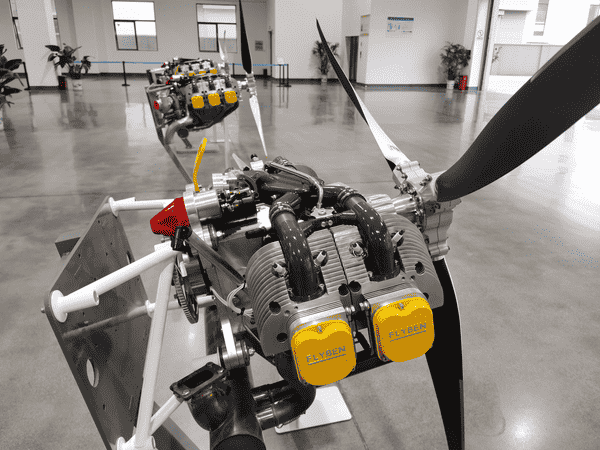
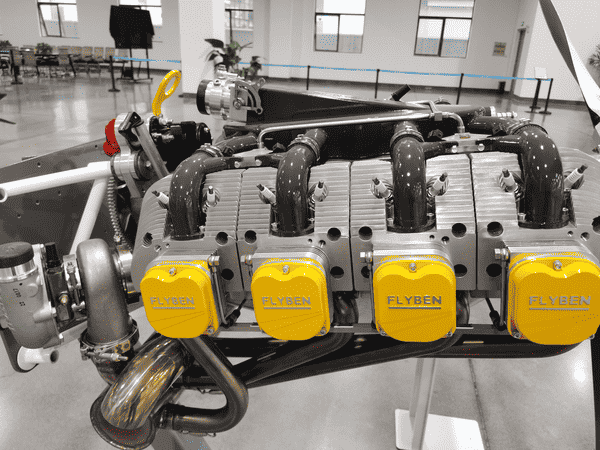
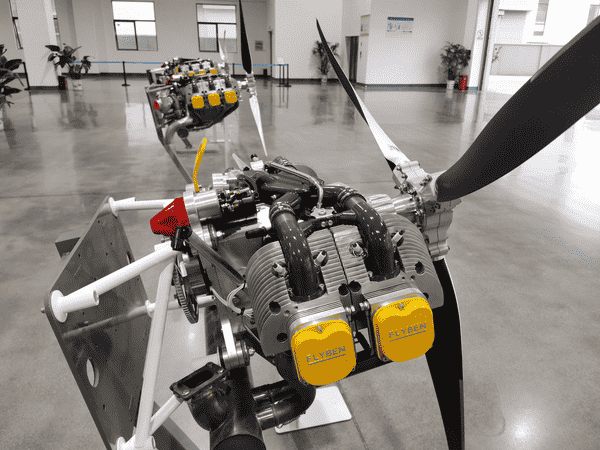
The FB100 family uses a four-cylinder, four-stroke, horizontally opposed, air-cooled layout. A single-stage gear reduction drives the propeller shaft. ECU-controlled electronic fuel injection, dual ignition and electric start are standard across the platform. The FB100 is naturally aspirated; the FB100T adds a turbocharger with automatic wastegate control. This section compares the two aviation engine variants side by side.
Both variants share the same bore, stroke and displacement family, so mounting dimensions, accessory layout and maintenance habits stay close. A mechanic trained on one Flyben engine can service the other with limited extra instruction, and spare parts cross over between the two aircraft engine variants.
FB100 Naturally Aspirated Aviation Engine
The FB100 is our entry-level aircraft engine for airframes that do not need turbocharged high-altitude output. It runs on RON 98 gasoline. The firing order is 1-3-2-4, and the throttle is manual. It suits low-altitude sport aircraft, training airframes and light experimental projects where a simple, proven aircraft engine keeps maintenance costs down.
Item | Specification | Item | Specification | Item | Specification |
|---|---|---|---|---|---|
Configuration | 4-cylinder, 4-stroke, horizontally opposed, air-cooled | Compression ratio | 8.7 : 1 | Firing order | 1-3-2-4 |
Bore | 105.6 mm | Stroke | 80 mm | Displacement | 2800 cm³ |
Max continuous power | 95 HP / 71 kW, 205 N·m, shaft 3300 (2430) rpm | Max power | 105 HP / 77 kW, 211 N·m, 3500 (2580) rpm (max 1 min) | Fuel | RON 98 gasoline |
Reduction gear | Single-stage, 17/23 | Ignition | Dual electronic | Fuel delivery | ECU-controlled EFI, dual pump |
Oil capacity | 3.0–3.5 L; 15W-50 (0–35°C), SAE 40 (−10–0°C) | Alternator / rectifier | 350 W, DC 13.9 V, 25 A | Starting | Electric start |
Dry engine weight | 73.2 kg | Full operating weight | 90.2 kg | Optional front mount | 0.6 kg |
Intake | Naturally aspirated, manual throttle | Application note | Experimental and light-sport aircraft only | Data sheet | FB.E.PDS.01, Rev 1.1 |
On the bench, the FB100 delivers 95 HP at continuous rating and 105 HP for one minute at takeoff. Full operating weight, including exhaust, wiring, ignition, pumps, radiator, air filter and four liters of lubricant, is 90.2 kg. This aircraft engine is the lightest option in the current lineup, and this Flyben engine is priced for volume kit builders who want factory-direct pricing without an intermediary markup.
Choose the FB100 when your mission stays below dense-air altitudes and your airframe is light. It has fewer boosted parts to service, no intercooler circuit to inspect, and a shorter spare parts list. For a first-time builder or a training fleet, this naturally aspirated aircraft engine stays easy to maintain.
FB100T Turbocharged Aviation Engine
The FB100T keeps the same four-cylinder opposed core but adds forced induction. The turbocharger and automatic wastegate raise output and preserve power at altitude. Compression ratio drops to 8.0:1 to match the boost pressure. This aviation engine targets buyers who need altitude power without moving to a six-cylinder core. If your aviation engine will operate above dense-air levels, this variant is the first step up from the naturally aspirated FB100.
Item | Specification | Item | Specification | Item | Specification |
|---|---|---|---|---|---|
Configuration | 4-cylinder, 4-stroke, opposed, air-cooled, turbocharged | Compression ratio | 8.0 : 1 | Firing order | 1-3-2-4 |
Bore | 105.6 mm | Stroke | 80 mm | Displacement | 2800 cm³ |
Max continuous power | 122 HP / 91 kW, 263 N·m, shaft 3300 (2430) rpm | Max power | 137 HP / 100 kW, 274 N·m, 3500 (2580) rpm (max 1 min) | Fuel | RON 98 gasoline |
Boost control | Turbocharger, automatic wastegate | Reduction gear | Single-stage, 17/23 | Ignition | Dual electronic |
Oil capacity | 3.5–4.0 L; 15W-50 (0–35°C), SAE 40 (−10–0°C) | Alternator / rectifier | 350 W, DC 13.9 V, 25 A | Fuel delivery | EFI, dual electronic fuel pump |
Engine core weight | 83.9 kg (turbocharger and exhaust included) | Full operating weight | 100.5 kg | Optional front mount | 0.6 kg |
Intercooler package | Air filter, intercooler radiator and lines, 3.5 kg | Application note | Experimental and light-sport aircraft only | Data sheet | FB.E.PDS.02, Rev 1.1 |
Continuous output reaches 122 HP, and the one-minute takeoff rating reaches 137 HP. The full operating weight climbs to 100.5 kg, partly because the turbocharger, exhaust and intercooler package add mass. Buyers who choose this aircraft engine usually plan missions that need climb performance or higher cruise altitude.
The T variant adds a wastegate control loop and an intercooler radiator to the maintenance checklist. Inspect boost lines, intercooler hoses and exhaust joints during pre-flight and scheduled checks. As a boosted aviation engine, this Flyben engine rewards disciplined servicing; the turbo is reliable when intake air stays clean and oil changes follow the manual schedule.
FB160T Four-Cylinder Turbocharged Flyben Engine
The FB160T is a larger four-cylinder turbocharged aviation engine. Bore and stroke both grow compared with the FB100T, lifting displacement to 3520 cc. It keeps full air cooling, dual electronic spark ignition, electronic fuel injection, a wet forced-feed sump, integrated alternator, electric start and dual electronic fuel pumps.
Item | Specification | Item | Specification | Item | Specification |
|---|---|---|---|---|---|
Configuration | 4-cylinder, 4-stroke, opposed, air-cooled, turbocharged | Dimensions L×W×H | 520 × 739 × 490 mm | Rotation | Clockwise, rear view |
Bore | 105.7 mm | Stroke | 100.2 mm | Displacement | 3520 cc |
Compression ratio | 8.1 : 1 | Max service ceiling | 6500 m | Fuel | 98# gasoline / 100LL avgas |
Max torque | 390 N·m (145 HP) at 3000 rpm | Max power | 170 HP (370 N·m) at 3300 rpm | Generator | 30 A, 13.7 V |
Oil capacity | 3.3 L (min 2.8, max 3.5) | Ignition | Dual electronic spark | Fuel delivery | ECU-controlled injection |
Dry weight | 81.2 kg | Full operating weight | 94.5 kg | Lubrication | Wet sump, forced feed |
Starting | Electric start | Fuel pump | Dual electronic pumps | System note | Integrated alternator, full air cooling |
Peak output is 170 HP at 3300 rpm, with 390 N·m of torque at 3000 rpm. The dry engine weighs 81.2 kg and the full operating weight is 94.5 kg. Maximum service ceiling is rated at 6500 m. This Flyben engine fits medium-weight sport aircraft and UAV platforms that need more torque than the FB100T can offer. For a medium airframe, this aircraft engine balances output and installed weight better than over-sizing to a six-cylinder unit.
Between the FB100T and the FB160T, the deciding factor is usually airframe weight and payload. If your aircraft carries heavy payload, camera equipment, long-range fuel or extra crew, the larger displacement aircraft engine holds climb margin better at high gross weight. As an aviation engine for heavier sport airframes, the FB160T gives that margin; its 30 A generator covers modest avionics and payload loads.
FB200T Six-Cylinder Turbocharged Flyben Engine
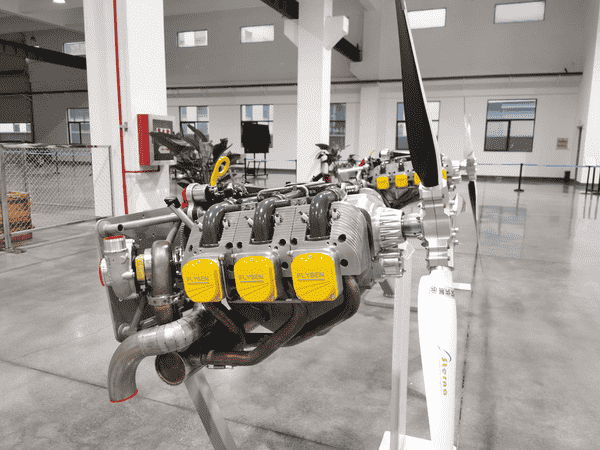
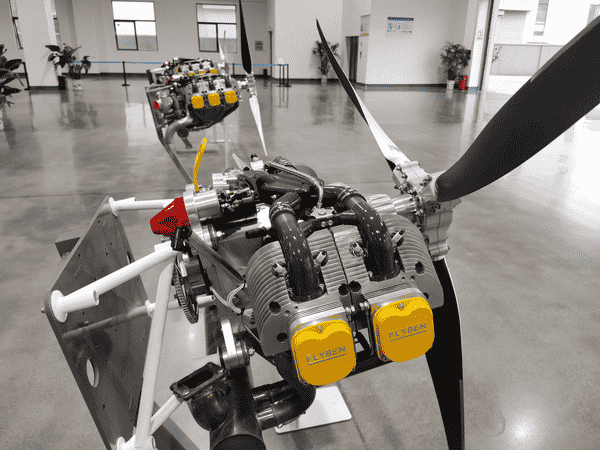
The FB200T moves to a six-cylinder horizontally opposed layout. It shares the 105.7 mm bore and 100.2 mm stroke of the four-cylinder turbo family, but three cylinders per bank raise displacement to 5295 cc. The target buyer is a manufacturer building a larger two-seat or four-seat airframe, or a heavy-lift unmanned platform that needs a steady aircraft engine at cruise power.
Item | Specification | Item | Specification | Item | Specification |
|---|---|---|---|---|---|
Configuration | 6-cylinder, 4-stroke, opposed, air-cooled, turbocharged | Dimensions L×W×H | 750 × 739 × 550 mm | Rotation | Clockwise, rear view |
Bore | 105.7 mm | Stroke | 100.2 mm | Displacement | 5295 cc |
Compression ratio | 8.1 : 1 | Max service ceiling | 6500 m | Fuel | 98# gasoline / 100LL avgas |
Max torque | 590 N·m (215 HP) at 2650 rpm | Max power | 250 HP (570 N·m) at 3000 rpm | Generator | 50 A, 13.7 V |
Oil capacity | 5 L (min 4.5, max 5.5) | Ignition | Dual electronic spark | Fuel delivery | ECU-controlled injection |
Dry weight | 107.9 kg | Full operating weight | 125.6 kg | Lubrication | Wet sump, forced feed |
Starting | Electric start | Fuel pump | Dual electronic pumps | System note | Integrated alternator, full air cooling |
The rated maximum power is 250 HP at 3000 rpm, and peak torque reaches 590 N·m at 2650 rpm. A 50 A, 13.7 V generator supplies electrical loads such as avionics, payloads and lighting. Dry weight is 107.9 kg; full operating weight is 125.6 kg. This aviation engine runs on 98# gasoline or 100LL avgas, giving operators fuel flexibility in markets where avgas is available. This aircraft engine is often specified when the airframe needs steady cruise power and a higher electrical load at the same time.
Six cylinders smooth out power pulses compared with a four-cylinder unit, reducing vibration felt in the airframe and cockpit. For a manned aircraft that passengers ride in, that comfort difference is noticeable. This Flyben engine is also a common choice for fixed-wing UAVs carrying sensor payloads sensitive to vibration and electrical noise, making the six-cylinder aviation engine a fit for both manned and unmanned installations.
FB300T Eight-Cylinder Turbocharged Flyben Engine
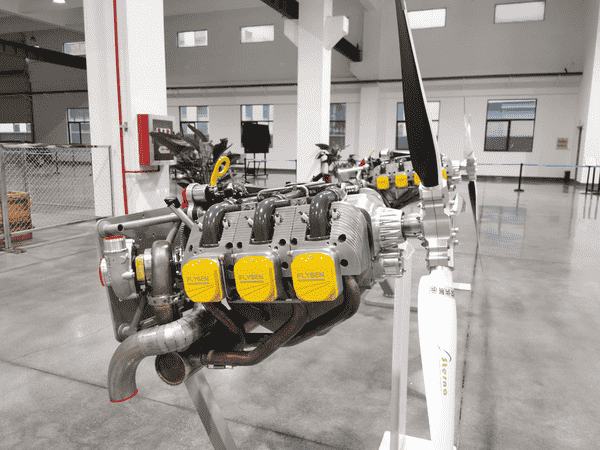
The FB300T is the largest aircraft engine in the current Flyben engine range. Eight cylinders in opposed layout, 7055 cc displacement and turbocharging deliver up to 350 HP at 3300 rpm. It is built for high-power experimental airframes, heavy-lift UAVs and specialized industrial propulsion projects that cannot be served by a four- or six-cylinder unit.
Item | Specification | Item | Specification | Item | Specification |
|---|---|---|---|---|---|
Configuration | 8-cylinder, 4-stroke, opposed, air-cooled, turbocharged | Dimensions L×W×H | 939 × 739 × 550 mm | Rotation | Clockwise, rear view |
Bore | 105.7 mm | Stroke | 100.2 mm | Displacement | 7055 cc |
Compression ratio | 8.1 : 1 | Max service ceiling | 6500 m | Fuel | 98# gasoline / 100LL avgas |
Max torque | 780 N·m (300 HP) at 2650 rpm | Max power | 350 HP (760 N·m) at 3300 rpm | Generator | 50 A, 13.7 V |
Oil capacity | 6.5 L (min 6, max 7) | Ignition | Dual electronic spark | Fuel delivery | ECU-controlled injection |
Dry weight | 153.6 kg | Full operating weight | 172.5 kg | Lubrication | Wet sump, forced feed |
Starting | Electric start | Fuel pump | Dual electronic pumps | System note | Integrated alternator, full air cooling |
Peak torque is 780 N·m at 2650 rpm. The 50 A generator and 6.5 L wet sump support long missions. Dry weight is 153.6 kg and full operating weight reaches 172.5 kg. This Flyben engine is supplied with the same dual ignition, dual fuel pump and ECU-controlled injection as the rest of the series, so maintenance training stays consistent across the lineup. Operators moving up from a smaller Flyben engine reuse much of their existing maintenance training.
The eight-cylinder package demands careful airframe integration. Mount stiffness, exhaust routing, cooling airflow and propeller load all need review before first run. Our engineering team works with the airframe designer on installation drawings, cooling checks and propeller matching. Treat this aviation engine as an integrated propulsion package, not a drop-in replacement for a smaller unit.
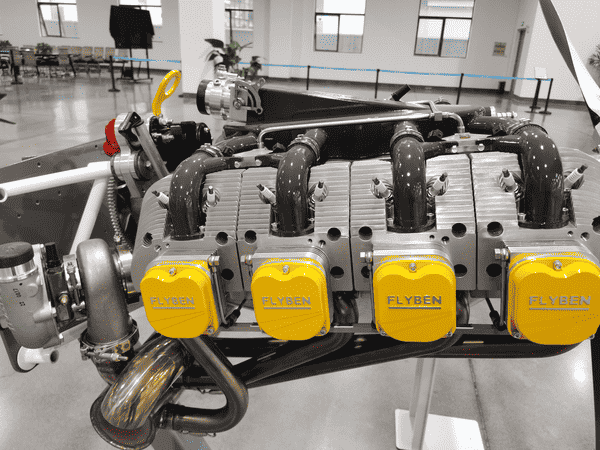
How Each Aircraft Engine Is Built and Shipped From Our Factory
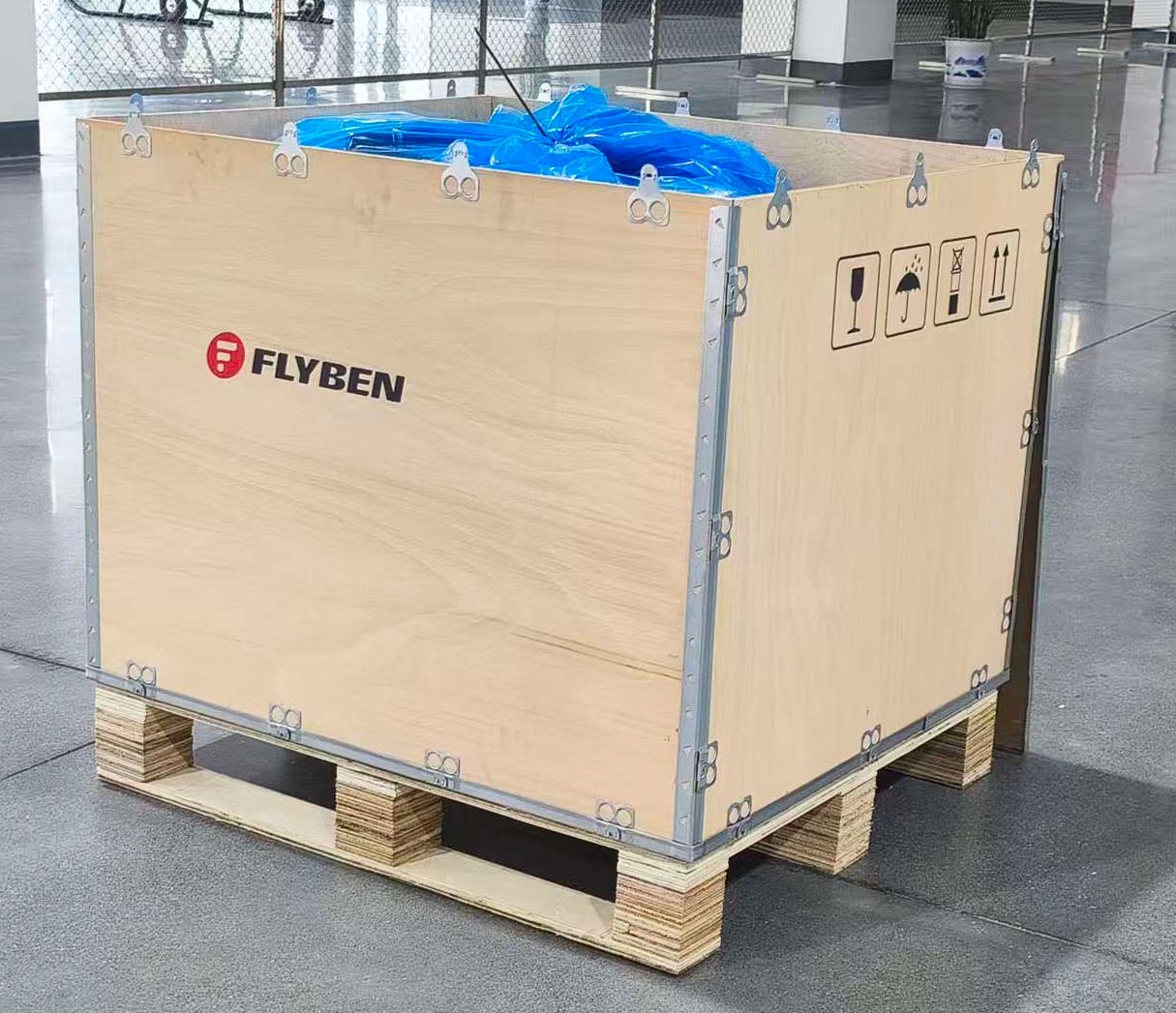
We build every Flyben engine in our own workshop, not through an outside assembler. The production flow runs from parts inspection, block and crankshaft assembly, gasket and sealing checks, turbocharger fitment on T variants, bench run-in, ECU calibration, final torque verification and crating. Every aircraft engine leaves the factory after a bench test, and the test report travels with the shipment.
Before an aircraft engine ships, our technicians record idle behavior, ignition checks, fuel pressure, charging voltage and oil pressure. Buyers receive the unit serial number, the bench report, the installation manual and a parts list. Every aircraft engine is sealed against moisture before crating, and the crate carries the serial number on the outside panel. We can ship crated engines by sea or air freight to most major cargo hubs. Export documentation is prepared by our export desk.
We accept factory inspection appointments for every aircraft engine on offer. You can visit the plant, watch a bench run, inspect machining and assembly areas, and talk to the assigned engineer. If travel is not practical, we arrange a live video tour of the workshop and tested units. A source factory that will not open its doors after deposit is a risk; we offer both options to reduce that risk.
Each unit carries a serial number tied to its build record. The record lists inspected parts, bench readings, ECU map version and the technician who signed off the test. When you order spare parts or file a service question, that record lets us trace which components are fitted on your specific Flyben engine.
Crating follows export packing practice. The aircraft engine is secured on a sealed base, accessories are bagged separately, and the crate is marked with serial number, gross weight and handling labels. Moisture protection is applied for sea freight. Spare parts ordered with the engine are packed in a separate box inside the same shipment.
During commissioning calls, buyers usually send photos of the mount, cowling, wiring and instrument readings. We review those before the first flight. Most setup questions are solved over a video call; only a few require replacing a sensor or harness part. This direct line between buyer and factory is one reason an aviation engine sourced here stays easier to support years after delivery.
Field Notes: Order Types We Handle and Issues We Have Solved
Over past production cycles, our aviation engine orders have covered kit aircraft, homebuilt projects, gyroplanes, light sport airframes and unmanned platforms. Most buyers come to us with a propeller requirement, an empty weight budget and a target mission profile. Each aviation engine order starts from mission data rather than a standard catalog push. We match a Flyben engine to those numbers before quoting power upgrades.
One recurring issue is fuel quality. Most problems reported on return shipments trace back to contaminated or stale fuel rather than the aviation engine itself. We specify RON 98 where listed, or 100LL for the T-series larger models. We advise buyers to install a fuel filter separator and to drain tank bottoms before first flight, especially after storage.
Mounting vibration is the second common lesson. An aircraft engine transmits vibration into the airframe through engine mounts and the reduction gearbox. Our units ship with shock-absorbing rubber mounts, and we recommend following the mount torque sequence in the installation manual. Re-torquing after the first break-in hours prevents loose fasteners in flight.
Break-in follows a fixed procedure. New engines should not run full throttle continuously during the early hours. The manual lists power limits and oil change intervals for the break-in period. Buyers who skip this step often report higher oil consumption later. We share the break-in schedule with every order and stay reachable by email or video call during commissioning.
Internal setup detail buyers rarely see: each ECU map is matched to the engine specification on that unit. Boost limits, ignition timing and fuel trim are calibrated during bench testing. A custom drive ratio or special electrical output goes through engineering review before production, rather than modifying a finished Flyben engine on the bench.
Common Mistakes When Buying an Aviation Engine From an Overseas Factory
The first mistake is choosing an aircraft engine by horsepower alone. A heavier airframe, larger propeller and denser payload all pull real power down. Compare torque curves, weight and fuel fitment together, not only the headline HP number. Ask for the rated output at the rpm band your propeller actually uses in cruise.
The second mistake is ignoring installed weight. The propeller, exhaust, mount, cowling and fuel all sit on the airframe alongside the aircraft engine. A unit that looks light on paper can still push useful load down once accessories are counted. Always plan with full operating weight from the spec sheet.
The third mistake is skipping local regulatory checks. Our piston units are built for non-certified experimental, amateur-built and light-sport use. They are not certified for commercial passenger operations. Ordering an aircraft engine before that check can lead to a unit you cannot register or operate locally. Confirm what your national authority allows before you commit to an order, and keep that constraint in the quotation stage rather than after delivery.
The fourth mistake is ordering without a bench test record. A factory that ships an aircraft engine without documented run-in leaves commissioning problems to the buyer. Our units ship with a bench report; use that document as the baseline for your first field checks. If readings on your first run differ sharply, raise it early rather than flying through the issue.
Why Buy Direct From a Source Factory Instead of a Trading Company
A trading company resells engines built by someone else, so it rarely holds bench data, spare parts stock or engineering access. When you buy an aircraft engine from our factory, the team that built the unit answers your technical questions. You get the bench report, build record and direct contact with the engineer. A Flyben engine ordered direct also carries factory warranty terms rather than a reseller's own policy.
Direct sourcing shortens the change loop. A revised mount, different harness length or custom electrical output goes straight to our engineering team. Through an intermediary, that message passes through two or three hands and details often get lost. For a specialized Flyben engine installation, that delay can cost weeks on the build schedule.
Frequently Asked Questions About Sourcing an Aircraft Engine From Our Factory
What aircraft and UAV types can your aviation engine be installed on?
The series is built for non-certified experimental, amateur-built and light-sport aircraft, and for unmanned platforms in similar weight classes. These engines are not certified for commercial passenger aircraft. Confirm your airframe category and local airworthiness rules before purchase. Our sales team can review the application with you.
How do I choose between the FB100, FB100T, FB160T, FB200T and FB300T?
Start with required horsepower and airframe weight. The FB100 covers low-power naturally aspirated use; the FB100T adds turbocharging in the 122-137 HP band; the FB160T reaches 170 HP; the FB200T covers 250 HP; the FB300T reaches 350 HP. Send your empty weight, propeller speed target and mission altitude, and we will shortlist one Flyben engine for you.
What fuel does each aircraft engine require?
FB100 and FB100T run on RON 98 gasoline. The FB160T, FB200T and FB300T accept 98# gasoline or 100LL aviation gasoline. Confirm which fuel your aircraft engine will use before you place the order. Do not run lower-octane fuel in turbocharged variants; knock damage is not covered under warranty terms listed in the manual.
Can I inspect the factory before ordering an aviation engine?
Yes. You can schedule an on-site visit or a live video inspection. We show the production line, bench test area and finished units, and we can answer engineering questions during the tour. Direct factory sales mean no trading company sits between you and the production team.
What is included when a Flyben engine ships?
The package includes the engine core, exhaust system where applicable, ECU and wiring harness, ignition coils and leads, rectifier, fuel pumps with filters, oil cooler and lines, vibration mounts, oil separator and hoses, air filter and intake lines, and the lubricant fill level listed in the sheet. Optional front mounting bracket is available on the FB100 and FB100T.
How long is the lead time for an aircraft engine order?
Standard built-to-stock models ship after bench testing within the lead time quoted on the proforma invoice. Custom calibration, special mounting or electrical changes add engineering time. An aviation engine built to a custom calibration also needs bench time before release. Confirm current capacity with our sales engineer at inquiry, because batch size and port congestion affect the shipping window.
Do you provide spare parts and after-sales support?
Yes. Spare parts for each aircraft engine are supplied per parts list, and warranty terms follow the installation manual. Keep the serial number and bench report for every claim. Technical support covers installation questions, run-in checks and field troubleshooting by email or scheduled video call.
What documentation accompanies an aviation engine for export?
Export documentation includes the commercial invoice, packing list, bench test report, installation manual and parts list. We coordinate with your freight forwarder or can recommend one we have worked with. Import eligibility depends on your national civil aviation authority; check local rules first.
How is the turbocharger maintained on the T-series models?
Turbo service follows the manual schedule: check boost lines and intercooler hoses for leaks, keep the air filter sealed, and change oil on time so bearing lubrication stays clean. Allow a short idle after high-power run before shutdown to let the turbo spool down. On this boosted aviation engine, treat the boost system as part of your regular inspection, not a sealed black box.
Can I customize mounts, wiring or output for my airframe?
Mounting brackets, harness routing and accessory layout can be reviewed for your installation. The optional front mounting bracket is already listed on the FB100 and FB100T sheet. We review each aircraft engine installation before approving mount or harness changes. Larger changes go through our engineering team before production. We prefer to document the change on drawings rather than improvise it on a finished aviation engine.
What makes this Flyben engine different from imported Western piston engines?
Western brands hold long certification histories, and we do not claim an equivalent airworthiness certificate. Our aircraft engine line targets experimental, amateur-built and light-sport applications where certified type design is not required. Buyers choose our units for direct factory pricing, shorter parts supply communication and configurable installation support. Compare specs, weight and service terms on your own airframe before deciding.
Do you sell engines separately from airframes?
Yes. We supply the aviation engine as a standalone propulsion unit, with accessories, manual and parts list included in the package. We do not build complete aircraft. Kit manufacturers and airframe builders integrate our Flyben engine into their own designs, and we support that integration with installation drawings and commissioning guidance.
External References, Factory Inspection Invitation and Next Steps
For background on how piston aircraft engines are classified, the Wikipedia aircraft engine entry explains piston versus turbine layouts and common terminology. EU buyers can review safety expectations through the European Union Aviation Safety Agency; US buyers can check the Federal Aviation Administration site for regulatory context. These external pages are references only; certification status in your country remains your local authority's call.
If you are comparing power, weight and price for your next aircraft engine, review the five Flyben models on this page and send us your airframe data. Compare each Flyben engine against your empty weight and mission altitude, then send the data our engineer needs. Our engineering team will reply with a matched recommendation, a factory test report sample and a video tour slot for our workshop.
For a deeper technical reference on piston versus turbine layouts and engine terminology, review the public aircraft engine overview on Wikipedia. Regulatory expectations for powered flight in Europe and the United States are published by the EASA and the FAA respectively. These links are third-party references for buyer research; they do not certify our units under any national airworthiness system.
Book a factory visit or a live video inspection of your next aircraft engine. Tell us your target horsepower, aircraft type and destination port. We will send the quotation, current spec sheet and lead time directly from the source factory, with no trading company between you and the production line.